
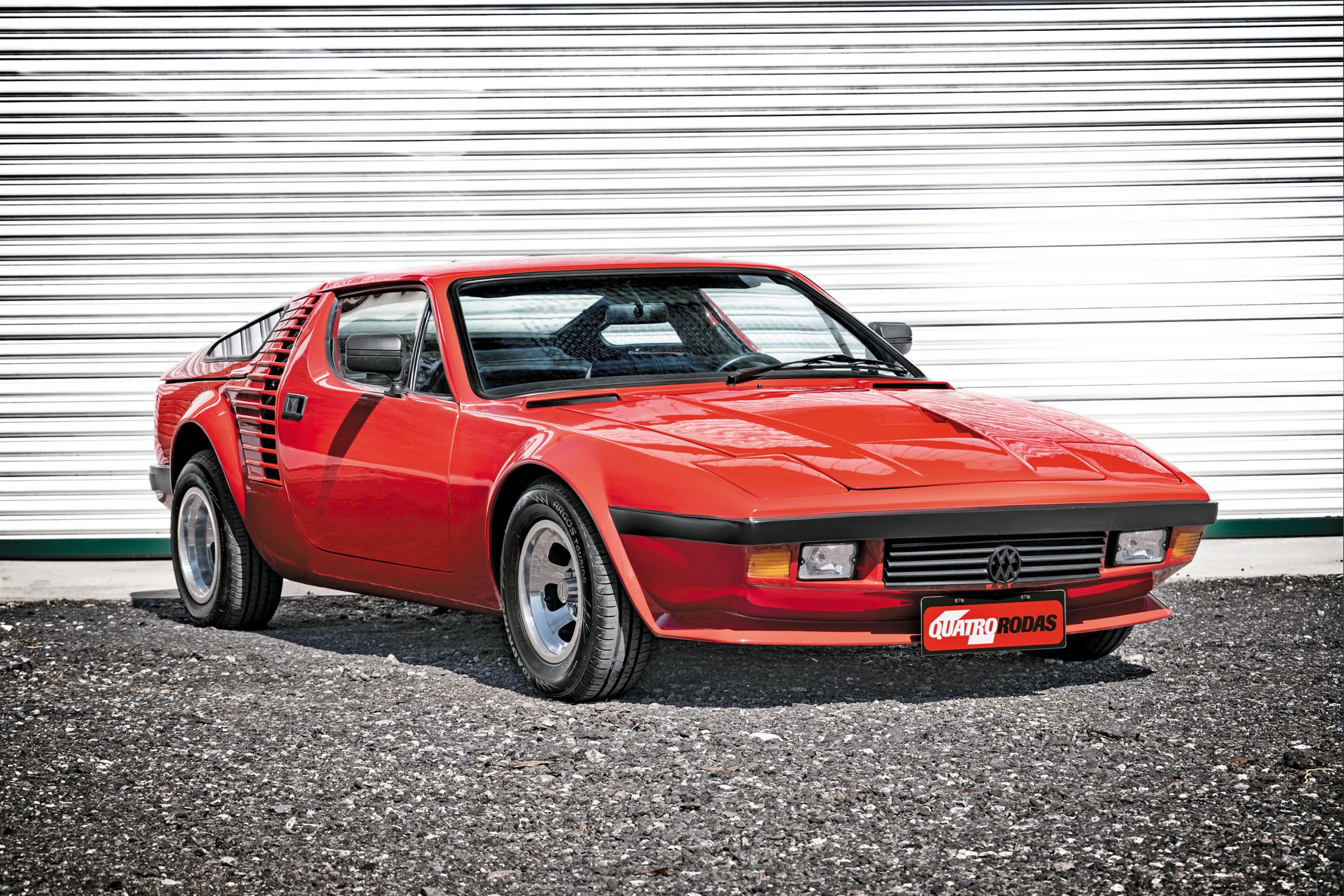
Nothing is known about the whereabouts of Wladimir Martins, the whimsical builder from Rio de Janeiro recognized as one of the forerunners of the Brazilian industry of exceptional automobiles. The few records and witnesses of his work indicate that he was one of those responsible for the development of the Woody Sport buggy and the WMV sports car , shown here.
The history of the WMV is intertwined with that of the GT Malzoni, conceived in 1975 by Francisco “Kiko” Malzoni. The sports car was developed with the blessing of his father, Rino Malzoni, one of the founders of Puma : the starting point was the body shape of the GT 4R, of which only three units were produced and raffled off among the readers of QUATRO RODAS magazine in 1969.
During the development of the sports car, Kiko Malzoni contacted his friend Antônio Pereira, from the company Polyglass, whose partner was Wladimir Martins, known for his meticulous work in laminating fiberglass-reinforced plastic.

Having achieved success, Polyglass was working at full capacity to meet the demand for the Woody Sport, but agreed to take the GT Malzoni prototype to Wladimir’s private workshop, where the final styling and construction details were defined.
Presented at the 1976 Auto Show, the GT Malzoni was so successful that 23 units were ordered during the event, an astonishing fact considering the high price charged for the sports car. Kiko soon realized that he would not be able to reconcile his economics studies with the production of the GT Malzoni and therefore sold the project to his friend José Marquês, who founded Marquês Indústria e Comércio de Veículos, in Matão (SP).

Some time later, Wladimir Martins Veículos emerged in Rio de Janeiro, founded in 1978 with the goal of producing five units per month of the WMV, a sports car that differed from the GT Malzoni in specific details, such as the air intake on the rear pillar, the integrated rear window, and the taillights from the Ford Maverick.
Interestingly, the WMV was reviewed by QUATRO RODAS in May 1978, three months before the GT Malzoni. Both were inspired by Marcello Gandini’s Maserati Khamsin, with a wedge-shaped front, steeply raked hood and windshield, and retractable headlights.

The level of equipment was adequate for the time. The instrument panel included a speedometer, tachometer, oil thermometer, vacuum gauge, fuel gauge, oil pressure gauge, voltmeter, ammeter, and an analog clock. The windows were electrically operated, and the sound system included a cassette player with AM/FM radio. Reclining seats upholstered in leather and jersey enhanced the feeling of comfort on board, favored by the traditional 2.4-meter wheelbase, a standard measurement for the Volkswagen Beetle and Brasilia. Rare at the time, the air conditioning system was advertised by the manufacturer as another comfort feature.
Even though outdated at the time, the fully independent suspensions overcame their technical limitations thanks to a firmer calibration and 7-inch wide alloy wheels with 205/60 R13 radial tires. Despite having two carburetors, its 1.6-liter engine resulted in figures below what was expected for such an expensive sports car: power was 66 hp at 4,600 rpm and torque was 11.7 kgfm at 3,200 rpm. Its high noise level was exacerbated by the manual transmission with only four speeds. Steering and brakes lacked any type of power assistance.


Named WM II, the second generation of the Rio de Janeiro sports car underwent substantial styling changes: the front was softened and the windshield wiper now used a single arm. Doors and sides make an immediate reference to the Alfa Romeo Montreal. The engine access cover incorporated the rear window and the taillights were from the Chevrolet Opala.
In 1982, production was transferred to Polystilo Ind. e Com., and it is estimated that just over 50 units were produced until 1983. The few remaining examples are now highly valued by collectors willing to take on the challenge of restoring them to their original specifications.
Technical Specifications – WMV II 1983
Engine: longitudinal, 4 opposed cylinders, 1,584 cm³ , two carburetors. Power: 65 hp at 4,600 rpm. Torque: 11.7 kgfm at 3,200 rpm.
Transmission: 4-speed manual, rear-wheel drive
. Body: closed, 2 doors, 2 seats.
Dimensions: length, 490 cm; width, 168 cm; height, 115 cm; wheelbase, 240 cm; weight, 760 kg.
Tires: 205/60 SR 13
May 1978 – Price: Cr$ 240,000