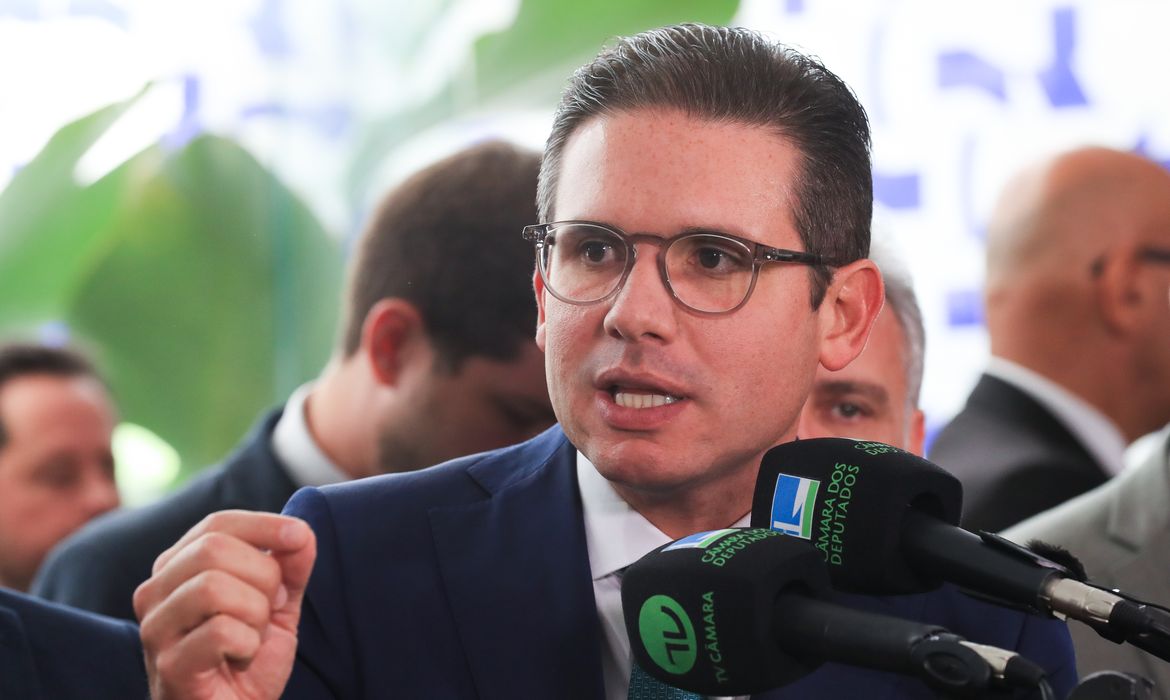
The Speaker of the House, Hugo Motta (Republicanos-PB) defended civil servant Mariângela Fialek, who was the target of search and seizure warrants by the Federal Police on Friday (12). Known as “Tuca”, she worked for the former Speaker of the House, Arthur Lira. 

“Civil servant Mariângela Fialek is a competent, responsible technician committed to the good management of public affairs,” Motta assured in a statement released last night.
Related news:
The current Speaker of the House, still defending her, added that the civil servant was fundamental in “improving the traceability systems for the proposal, indication, and execution of parliamentary amendments.”
“Secret budget”
Investigations indicate that Lira’s former advisor was responsible for sending orders to committees and determining the release of parliamentary amendments from the so-called “secret budget.” This is how the allocation of public funds without identifying the politician who made the allocation or the final beneficiaries became known.
The investigation into the civil servant was authorized by Minister Flávio Dino of the Supreme Federal Court (STF). However, Motta, in the statement, wrote that he found “no act of misappropriation of public funds. None” in the minister’s decision.
However, he noted that any irregularities should be properly investigated. Motta argued that it is important not to confuse the act of “merely indicating parliamentary amendments,” which are not mandatory, with the final execution of these funds by the end recipients.
“The proper execution of public resources and government transfers, not only parliamentary amendments but also those originating from the Executive Branch, by their final recipients, must be strictly monitored by the oversight bodies,” Motta stated.
Investigation
The investigations into the employee’s procedures began with the testimony of six parliamentarians and one employee of the Chamber of Deputies. The testimonies came from deputies Glauber Braga (Psol-RJ), José Rocha (União-BA), Adriana Ventura (Novo-SP), Fernando Marangoni (União-SP), Dr. Francisco (PT-PI), and Senator Cleitinho (Republicanos-MG). According to the testimonies, Tuca forwarded official letters from the Presidency of the Chamber to committees ordering the release of amendments, especially for Alagoas, the parliamentarian’s home state.
Lira’s former aide, who now holds a position in the PP party’s presidential office in the Chamber of Deputies, had already had her telecommunications privacy breached. However, the Federal Police indicated the need to conduct searches after finding no saved messages on devices or data clouds, although they did find evidence of criminal activity.
Dino authorized the searches given the “concrete possibility that the defendant may have adopted conduct aimed at preventing the backup of her most sensitive data in a cloud environment, maintaining files in physical media (paper, machines, etc.)”.
The minister stressed that the evidence points to “continuous, systematic and structured action” in the organization of the secret budget.
Flávio Dino is also the rapporteur for a case in which the Supreme Court prohibited the practices of secret budgeting, requiring the Chamber of Deputies to adopt minimum criteria for transparency and traceability of public money all the way to the final recipient.
“Forced redirection”
The statements reinforce the suspicion that there was a “forced redirection” of amendment funds by Lira, Minister Flávio Dino emphasized.
In a partial report, the Federal Police highlighted how, since 2020, Tuca has held several strategic positions in public companies and in the Legislative branch, always at Lira’s recommendation, which allowed her to manipulate the allocation of amendments.
After finding a handwritten note that coincides with the allocation of amendments, the investigators highlighted “the unusual disregard for formality” in the formulation of the Union Budget.
“A handwritten note, done in a rudimentary manner, was responsible for the reallocation of resources from one municipality to another. Regrettably, it is impossible not to compare the way the secret budget coordinated by TUCA was controlled and organized to a ‘back-of-the-envelope calculation’,” the investigators wrote.