
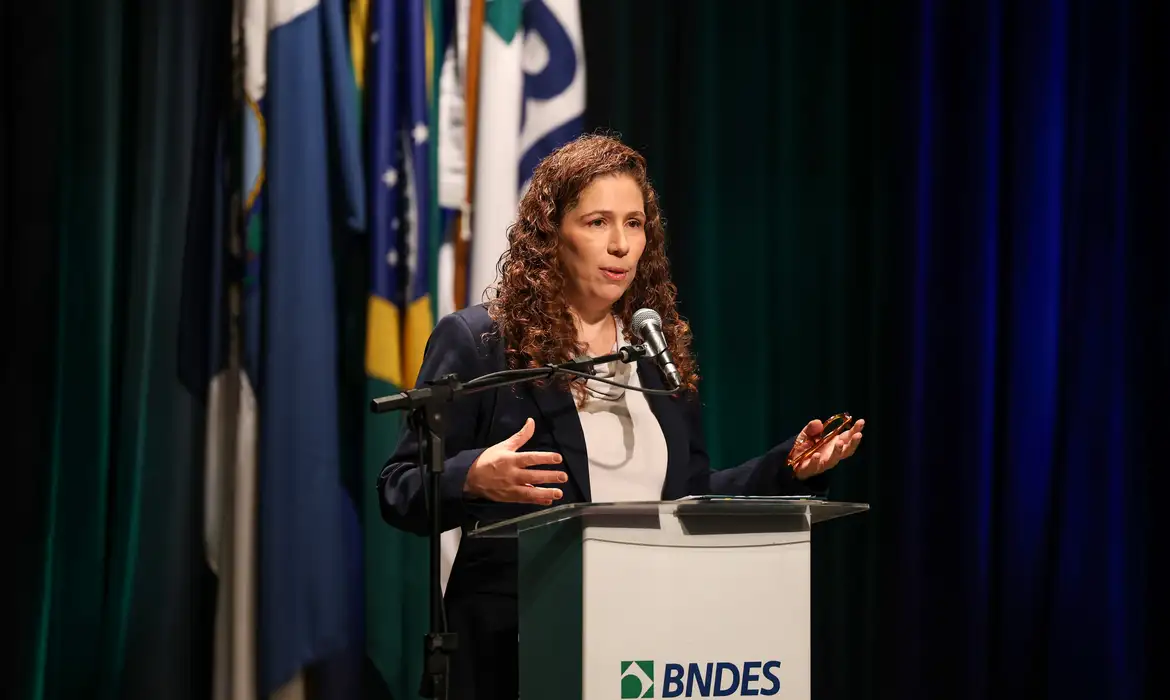
The Minister of Management and Innovation in Public Services , Esther Dweck, on Monday (15) countered criticism against the existence of state-owned companies and stated that, in some cases, privatization represents a worsening of services to the population. Dweck reinforced that the government expects to approve, soon, a restructuring plan for the Post Office, a company in financial difficulty.

“State-owned companies are not a burden on Brazilian society. On the contrary, they are an asset of the Brazilian people and a valuable resource for sustainable development with economic, environmental, and social responsibility.”
Related news:
- Lula highlights the opening of 500 international markets for agribusiness.
- Director says Federal Police do not measure “political stature” when investigating amendments.
- Brazilians are talking less about politics on WhatsApp, study shows.
The statement was made by the minister during the event “Democracy and Human Rights: Companies United for a More Equal Brazil ,” held at the headquarters of the National Bank for Economic and Social Development (BNDES) in Rio de Janeiro.
The minister believes that state-owned companies “have been heavily attacked recently” and, in defending them, pointed out that they were “extremely important for building infrastructure,” as well as integrating regions, generating jobs, sustaining strategic capacity, sovereignty, energy security, applied research and innovation, long-term credit and financing, and essential services “where a strictly private logic would never have reached.”
“Without them, many rights, services, and opportunities simply wouldn’t exist,” he said.
Privatization
The minister criticized the idea that privatization is always a solution to problems and recalled the case of São Paulo, where the concessionaire Enel has been held responsible for delays in restoring electricity after heavy rains and strong winds.
Learn more: Blackout: experts point to the failure of the privatization model.
“Imagine in a middle- and lower-class neighborhood, people going without a refrigerator for two days, for example, all they have. An extremely serious situation,” he emphasized.
The Minister of Management and Innovation in Public Services commented on the case of the Post Office, a company facing cash flow difficulties and negotiating with the government to receive capital injections and guarantees to obtain loans.
The minister pointed out that the state-owned company is going through a financial crisis because it belongs to a “sector that is experiencing problems worldwide.”
Dweck pointed out that the company provides a service mandated by the Constitution to universalize postal service and that it needs to be present in all Brazilian municipalities. “This, obviously, generates a cost for the company that it used to bear alone.”
The minister commented that in other countries the service has been associated with other activities as a means of support, and informed that the government has been working for a year to rethink the restructuring of the company.
“We will soon approve a restructuring plan for the company so that it can rethink its operations,” he indicated.
The minister explained that the state-owned company’s situation was aggravated by the fact that previous governments had placed it on a list of potential privatizations, inhibiting investments in restructuring.
Potential of state-owned companies
Minister Esther Dweck criticized assessments that consider this specific case to “try, in some way, to talk about the management of all companies.”
Dweck highlighted the investment power of state-owned companies, citing 23 that are part of Central Bank statistics. According to her, in 2.5 years of government, these companies invested R$ 12.5 billion, a volume almost six times greater than the R$ 2.1 billion invested in the same period of the previous government.
The minister also criticized analysts who, in her view, confuse deficit with loss. Dweck explains that a company can have a profit and, at the same time, a deficit. “Spending money that was in cash to invest, therefore, from an accounting and tax point of view, is a deficit.”
Business pact
The event at BNDES was attended by representatives from the public sector, public and private companies, and civil society organizations. CEO Andre Basbaum represented Empresa Brasil de Comunicação ( EBC ), to which Agência Brasil is affiliated .
The Minister of Human Rights and Citizenship, Macaé Evaristo, said in her speech that a pact between companies and human rights is necessary.
“We are not enemies of the companies,” said Macaé.
“We want companies on our side as agents of transformation, helping us to build a better world. Choosing a pact for transformation, for life, for dignity, and for democracy,” he added.


Macaé Evaristo says he wants private companies working alongside the government – Tomaz Silva/Agência Brasil
Private initiatives
Luiza Helena Trajano, the chairwoman of the board of directors of the retail chain Magazine Luiza, participated in the meeting via video call and presented the company’s initiatives in support of diversity.
The executive highlighted the 2020 trainee program, which was exclusively for Black people.
“We felt that Black people didn’t hold high-level positions in the company, and we had to do something about it. For us, the trainee program was the best thing that could be done,” she says.
The initiative attracted backlash and was even challenged in court .
“We endured a week of every possible criticism, but then, shortly after, we received awards from all over the world,” he recalls.
Criticism of the end of quotas

Mercadante criticized the movement to eliminate the quota policy in Santa Catarina – Tomaz Silva/Agência Brasil
The president of BNDES, Aloizio Mercadante, took advantage of the meeting to repudiate the approval of a bill by the Legislative Assembly of the State of Santa Catarina (Alesc) last week, which prohibits quotas for black people in universities in the state, a decision that still needs the sanction of the state government to take effect.
“I was very indignant about this decision. This type of regression is unacceptable,” declared Mercadante, who was Minister of Education when the Quota Law in federal universities was created in 2012.
He highlighted the fact that the last BNDES (Brazilian Development Bank) recruitment process, held in 2024, reserved 30% of the positions for Black people.
“What we need is to create opportunities. That’s how we’re going to fight inequality in this country and change history,” he emphasized.